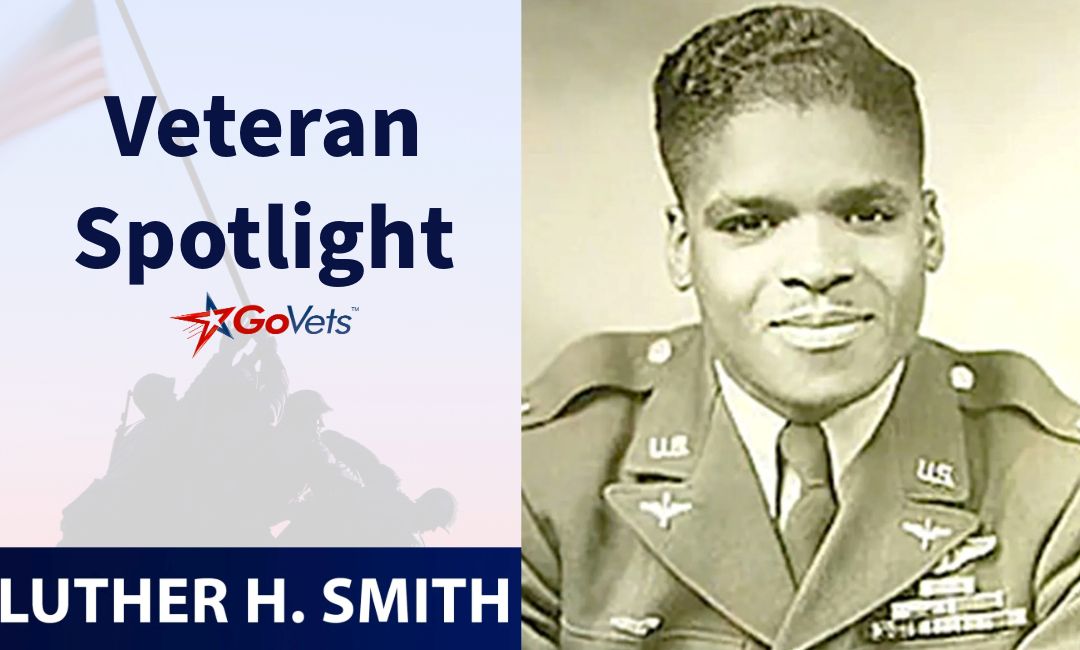
Luther H. Smith was born in September 1920 in Des Moines, Iowa, as the second of nine children. His fascination with aviation began after his first flight in a Ford Tri-Motor aircraft and watching military pilots deliver mail in open-cockpit planes. Following high school, he pursued mechanical engineering at the University of Iowa. In 1939, when the United States launched the Civilian Pilot Training Program, Smith took advantage of the opportunity, earning his pilot’s license in 1940.
Smith's military journey began in 1942 when he became the first African American from Iowa to join the Army Air Corps. After completing nine months of aviator training at Tuskegee Airfield in Alabama, he was commissioned in May 1943. As a member of the renowned Tuskegee Airmen, he quickly proved his capabilities during World War II, flying 133 combat missions with the 302nd Fighter Group. His aerial prowess was evident as he shot down two enemy aircraft in combat and destroyed ten more on the ground.
In October 1944, Smith encountered one of his most harrowing experiences. While escorting bombers, his P-51 Mustang, part of the legendary “Red Tails,” was severely damaged during a raid over Yugoslavia. Forced to parachute from his burning aircraft, he sustained significant injuries and was captured by German forces. Enduring seven months as a prisoner of war in Austria, he faced frequent questioning from his captors about why, as a Black man, he fought for the United States. His son, Gordon, recalled that Smith would always respond with pride in his service. By the time he was liberated in May 1945, he weighed just 70 pounds and required two years of hospitalization and 18 surgeries to recover.
Smith’s service and contributions earned him numerous honors, including the Distinguished Flying Cross, an Air Medal with six Oak Leaf Clusters, a Purple Heart, a Prisoner of War Medal, and eight European and Mediterranean Theater Campaign Ribbons. His achievements extended beyond the military, receiving a Distinguished Alumni Award from the University of Iowa, a Franklin W. Kolk Aerospace Industry Award from the Society of Automotive Engineers, and induction into the UI Distinguished Engineering Alumni Academy.
After retiring as a captain in 1947, Smith returned to the University of Iowa to complete his engineering degree. Despite facing discrimination in the workforce, he secured a role at General Electric, where he excelled as an aerospace engineer for 37 years. His civilian contributions were just as impressive, holding two U.S. patents for aircraft sealing devices and collaborating with the Air Force, NASA, and the Navy Submarine Command. He was later honored as a member of the Iowa Aviation Hall of Fame.
In 1995, Smith traveled to Europe with President Bill Clinton and six other veterans to mark the 50th anniversary of World War II’s end. He also played a key role in selecting the design for the National World War II Memorial, dedicated in 2004. That same year, he led the 60th-anniversary commemoration of the Tuskegee Airmen’s remarkable record of escorting bombers on 200 missions without losing a single one to enemy fighters.
Smith passed away in 2009 in Villanova, Pennsylvania, and was laid to rest at Arlington National Cemetery.