

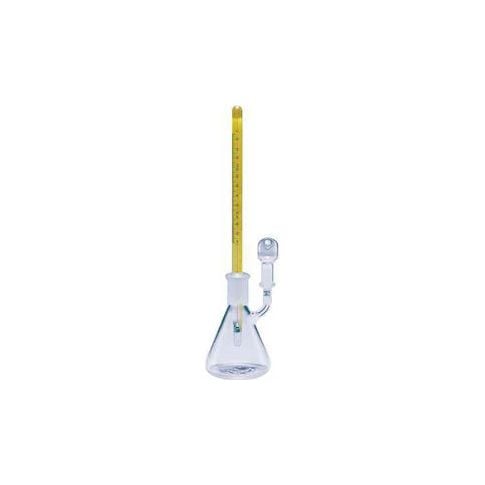
Kimble® Kimax® Pycnometer 10ML No Mercury 15123N-10
Kimble® Kimax® Pycnometer 10ML No Mercury
Measure the densities and specific gravities of liquids and solids with precision using the Kimble Kimax Pycnometer. This versatile tool is designed for a variety of applications, including pigment analysis (ASTM D153) and chemical testing. Manufactured from low-extractable borosilicate glass, the pycnometer ensures accurate and reliable results. By following a simple procedure, users can easily calculate specific gravity and determine the weight of unknown liquids. Ideal for use in laboratories and research settings, the Kimble Kimax Pycnometer is a valuable asset for chemists, physicists, and materials scientists. Its accuracy and durability make it a trusted tool for precise measurements.
Top product features:
- Conical body for maximum stability
- Standard taper 10/18 thermometer with a range of 14 to 38 degrees C in 0.2 degree increments
- Manufactured from 33 expansion low extractable borosilicate glass conforming to USP type I and ASTM E438 type I class A requirements
Top product applications:
- Density measurement of liquids and solids
- Pigment analysis in accordance with ASTM D153
- Quality control in chemical manufacturing processes
Kimble® kimax® pycnometers designed for measuring and comparing the densities or specific gravities of liquids and solids. 15123n series thermometers are non-mercury spirit-filled supplied with standard taper 10/18 thermometer with a range of 14 to 38 degrees c in 0.2 degree increments thermometer is retested for accuracy within ± 0.2 degrees c standard taper 5/12 side tube cap has a small vent near the top body is conical for maximum stability capacity is within 10 percent of nominal shown on the flask each flask body is numbered for ready identification the 50ml size may be used to obtain the specific gravity of pigments (astm d153) manufactured from 33 expansion low extractable borosilicate glass conforming to usp type i and astm e438 type i class a requirements procedure for use of 15123n thoroughly clean dry assemble and weigh the empty pycnometer and record. Fill with recently boiled distilled water at a temperature a degree or two below the determination temperature. Insert thermometer into the bottle forcing water through the overflow tube. Place in a constant temperature bath and when the desired temperature is reached wipe off excess water from the overflow tube tip and cap. Remove from bath wipe dry reweigh and record. Weight difference is that of the water in the flask - the volume of the pycnometer may be calculated. Repeat process with liquid of an unknown specific gravity and record the weight difference. Calculation specific gravity (weight of liquid of unknown s.G (weight of water at same temperature) please note some of these items contain mercury. Exposed mercury can evaporate and become an invisible odorless toxic vapor. Use caution in storing and handling this product. Products containing mercury should not be put in the trash; they must be recycled or disposed of as hazardous waste according to state and local laws.
Additional Information
- UNSPSC: 41103209
- Brand: CP LAB SAFETY.
- Color: Multi-colored
- Package Quantity: 1
- Country of Origin: MX
- FOB Origin: CA
- Ships by: PARCEL
- Comes in a kit: No
- Newly added to catalog: No
- Item is on Clearance: No
- Contains Hazardous Materials: No
- CA Proposition 65 Applies: No
- Package Length: 12.00
- Package Width: 12.00
- Package Height: 12.00
- Package Weight: 6.00
Product info last updated on June 19, 2025 7:31am UTC
Category: Labware and Utensils