

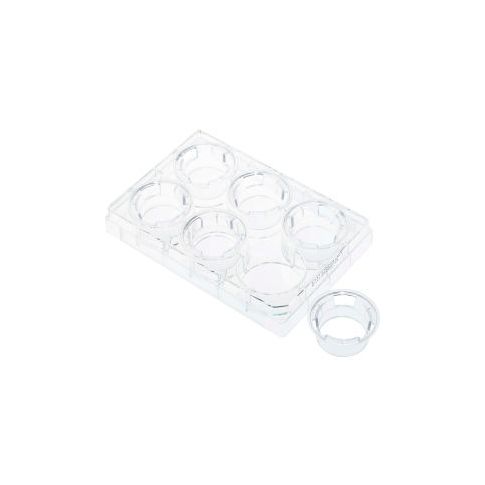
CELLTREAT® Permeable Cell Culture Inserts Packed in 6 Well Plate Hanging PET 0.4m Sterile 230607
Discount: See in Cart
Free Shipping
In Stock
Free Shipping
In Stock
SKU
281-82508B27
CELLTREAT® Permeable Cell Culture Inserts Packed in 6 Well Plate Hanging PET 0.4m Sterile
CELLTREAT Permeable Cell Culture Inserts provide a unique platform for in vitro studies, mimicking in vivo conditions. The inserts, with a 0.4μm pore size, allow for co-culture and drug transport studies, while 3.0μm and 8.0μm pore sizes are ideal for angiogenesis and chemotaxis experiments. Cells can be cultured on both sides of the membrane, enabling the study of cell-cell interactions, drug transfer, and transport. The inserts can be easily transferred to new plates, reducing the need for extensive setup and maintenance. This product is suitable for a variety of applications, including drug development, tissue engineering, and basic research.
Top product features:
- Permeable cell culture inserts mimic in vivo conditions
- Membrane remains suspended above well bottom allowing co-culture
- 0.4µm pore size is ideal for co-culture and drug transport studies
Top product applications:
- Ideal for drug transfer assays
- Transport studies
- Migration assays
Ul style 'margin-top 0px; padding-top 5px; padding-bottom 5px;' permeable cell culture inserts mimic in vivo conditions inserts center in wells preventing membrane from touching sides and wicking between insert and side wall membrane remains suspended above well bottom allowing co-culture grow one cell line inside insert and another below in the well ideal for drug transfer assays transport studies migration assays and cell-cell interaction studies transfer cultures to fresh media by moving the insert to a new plate 0.4µm pore size is ideal for co-culture and drug transport studies 3.0µm and 8.0µm pore size are ideal for angiogenesis and chemotaxis experiments for more help with membrane selection please contact celltreat scientific products non-treated plates sold separately; carrier plate is tissue culture treated which encourages cell adhesion
Additional Information
- UPC: 810025333461
- UNSPSC: 41121812
- Brand: CELLTREAT SCIENTIFIC PRODUCTS LLC
- Color: Natural
- Package Quantity: 1
- Country of Origin: CN
- FOB Origin: MA
- Ships by: PARCEL
- Comes in a kit: No
- Newly added to catalog: No
- Item is on Clearance: No
- Contains Hazardous Materials: No
- CA Proposition 65 Applies: No
- Package Length: 11.00
- Package Width: 6.00
- Package Height: 3.00
- Package Weight: 1.00
Product info last updated on May 19, 2025 3:16am UTC
Category: Labware and Utensils